What this tool does
Your basal metabolic rate (BMR) is the energy your body uses in a day at complete rest, just to breathe, keep warm and keep its organs working. This calculator uses the Mifflin-St Jeor equation, published in 1990 from measurements of 498 healthy adults aged 19 to 78, and multiplies it by one of five common activity factors to estimate the calories you use on an ordinary day, often called maintenance calories or TDEE.
Pick a goal and it subtracts or adds 250 to 1,000 calories a day, then shows the weekly change that goes with it under the usual rule of thumb of 3,500 calories per pound (about 7,700 per kilogram). If the goal would take you below your BMR, the page says so plainly.
To explain why different calculators disagree, the Harris-Benedict equation as revised in 1984 sits next to Mifflin-St Jeor, and if you know your body fat percentage the Katch-McArdle equation, which works from lean mass, is added. Everything is worked out inside this browser.
How to use it
- Choose pounds and feet or kilograms and centimetres, then tap your sex and enter your age, height and weight. One decimal place is fine.
- Pick the activity level closest to a normal week. If you are torn between two, the lower one is the safer choice.
- Choose a goal to see a daily target next to your maintenance calories for every activity level.
- Press Print to put the tables, your inputs and the sources on one sheet of A4 or Letter paper, or save it as a PDF from the print window.
How the Mifflin-St Jeor number is worked out
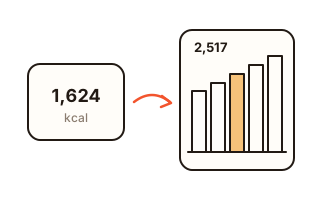
For men the equation is 10 × weight in kg + 6.25 × height in cm − 5 × age + 5; for women the last step subtracts 161 instead of adding 5. A 35-year-old man who is 5 ft 9 in and 154 lb (175.26 cm, 69.85 kg) comes out at 1,624 calories a day. Pounds and inches are converted with the exact definitions, 0.45359237 kg and 2.54 cm.
Daily calories are the unrounded BMR times the activity factor, rounded once at the end: 1.2 for little or no exercise, 1.375 for light exercise one to three days a week, 1.55 for three to five days, 1.725 for hard exercise six or seven days, and 1.9 for a physical job plus daily training. These factors are widely used estimates rather than an official standard.
Why calculators give different answers
The Mifflin team reported that the original 1919 Harris-Benedict equations overestimated measured resting energy by about 5 percent, which is why most current calculators lead with Mifflin-St Jeor. The 1984 revision of Harris-Benedict gives the same 35-year-old man 1,667 calories, 43 more. Some sites also round the BMR before multiplying, which moves the result by a calorie or so; this page keeps every coefficient as published and rounds only the final figure.
Using a calorie target sensibly
Eating 500 calories a day under maintenance is often said to lose about a pound a week, but that rule ignores the fact that your energy use falls as your weight falls, so real progress slows over time. Treat the weekly figure as a rough guide.
These are estimates for healthy adults, not medical advice. They do not fit children and teenagers who are still growing, pregnancy or breastfeeding, or medical conditions. If a plan puts you below your BMR for more than a short while, talk to a doctor or a registered dietitian first.
Your data
Your age, height, weight and body fat are used only inside this browser and never sent anywhere. Body measurements are not saved; only the unit, activity level and goal you picked are kept in this browser for next time.
Questions and answers
Is it safe to eat less than my BMR?
Going below your BMR for long can leave you short of energy and nutrients. The page warns you when a goal does that. Check with a doctor or registered dietitian before following such a plan.
Why does my fitness watch show a different number?
A watch estimates the energy you used today from your heart rate and movement. This page uses an equation that predicts an average person of your size and age, so very muscular or very lean bodies can differ. If you know your body fat percentage, enter it to see the Katch-McArdle figure, which is based on lean mass.
Which activity level should I choose?
If you sit most of the day and do not exercise, choose the first level; light exercise one to three days a week is the second. Count only exercise that makes you breathe hard. When in doubt, pick the lower level so the estimate does not run high.
Can teenagers or pregnant women use it?
The equation was built from adults aged 19 to 78. Growing teenagers, pregnancy, breastfeeding and illness all change energy needs, so the numbers will not fit. The page shows a note for ages under 18 or over 80.
Should I recalculate as my weight changes?
Yes. Your BMR drops as you lose weight, so enter your new weight every few pounds to keep the target realistic. Your activity level and goal stay remembered in this browser, so only the numbers need retyping.